
Why Epoxy Yellows
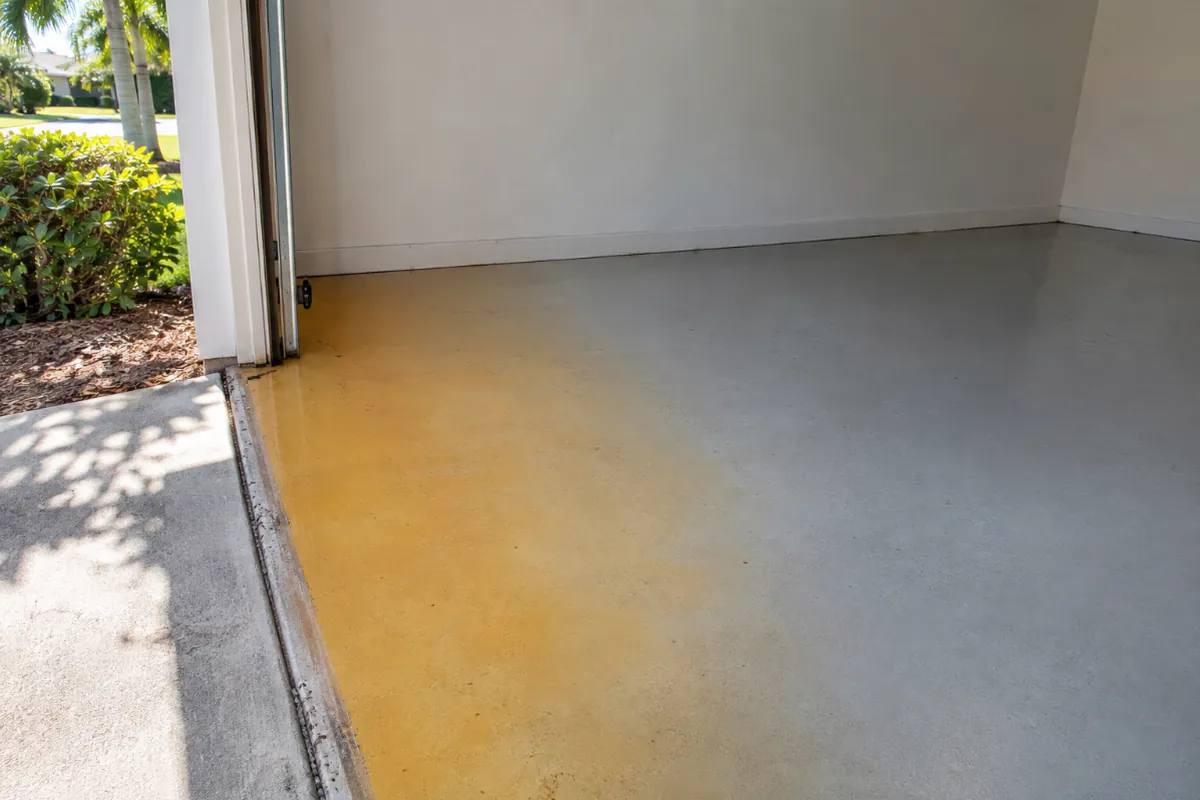
Most floor epoxies are aromatic. Ultraviolet light breaks down that chemistry at the surface, and the coating slowly ambers. Indoors that barely matters; in a garage whose door stays open to Florida sun, it shows as a yellow band from the door inward, exactly where the light lands.
Yellowing is cosmetic, not a failure of the bond. But it's permanent, and it's the most common complaint we hear about older epoxy floors in Palm Beach County.
What Polyaspartic Does Differently
Polyaspartic is a type of polyurea. Its aliphatic chemistry is what makes it UV stable, so it holds its color in sunlight. It also cures much faster than epoxy.
| Epoxy | Polyaspartic | |
|---|---|---|
| Sunlight | Can yellow over time | Resists yellowing |
| Cure speed | Slower | Faster |
| Working time | Longer, more forgiving | Shorter, needs a practiced crew |
| Film per coat | Builds thick | Builds thinner |
| Best job | Base coats, flake and metallic work | Topcoats and sun-exposed floors |
Sunlight
- Epoxy
- Can yellow over time
- Polyaspartic
- Resists yellowing
Cure speed
- Epoxy
- Slower
- Polyaspartic
- Faster
Working time
- Epoxy
- Longer, more forgiving
- Polyaspartic
- Shorter, needs a practiced crew
Film per coat
- Epoxy
- Builds thick
- Polyaspartic
- Builds thinner
Best job
- Epoxy
- Base coats, flake and metallic work
- Polyaspartic
- Topcoats and sun-exposed floors
Why Most Florida Floors Use Both
The two coatings are good at different layers. Epoxy builds a thick, strong base and gives the crew time to broadcast flake or work a metallic pour. Polyaspartic makes a hard, clear top layer that won't yellow where the sun hits.
- 1. Diamond grind and repair the slab.
- 2. Lay an epoxy base coat, chosen for the slab's moisture.
- 3. Broadcast flake or apply color.
- 4. Seal it with a clear polyaspartic topcoat.
Some floors are polyaspartic from top to bottom, which shortens the job further. It depends on the slab, and it's something we decide at the estimate.
When Plain Epoxy Is Fine
- Interior rooms with no direct sun, like a laundry room or a back storage area.
- Commercial back-of-house floors under a roof, away from open bay doors.
- Base coats under a polyaspartic topcoat, where the sun never reaches the epoxy.
Fixing a Yellowed Epoxy Floor
If an old epoxy floor is still well bonded, it can often be cleaned, abraded and recoated with a polyaspartic topcoat. If it's peeling or lifting, it has to be ground off first, because a new coat is only as strong as what it's bonded to.
Asked often
Polyaspartic and Epoxy Questions
Is polyaspartic the same as polyurea?
It's a type of polyurea. Standard aromatic polyurea can yellow; polyaspartic is the aliphatic kind that holds its color in sunlight.
Is polyaspartic always better than epoxy?
No. Epoxy builds thicker base coats and gives more working time. Most good garage floors use an epoxy base and a polyaspartic topcoat.
Will a polyaspartic topcoat stop my floor yellowing?
A UV-stable topcoat protects the layers under it from sunlight, so the floor holds its color where the sun reaches it.
Why is polyaspartic harder to install?
It cures fast, so the crew has less time to spread it once it's mixed. That's why it's mostly a professional product.
Can you put polyaspartic over my old epoxy floor?
Sometimes, if the old floor is well bonded. It's cleaned and abraded first. A peeling floor is ground off instead.
Sources
- ArmorGarage, Epoxy vs. Polyurea vs. Polyaspartic Floor Coatings (July 2025)