
Where Slab Moisture Comes From
Concrete is porous. A slab poured on the ground keeps drying for a long time, and it can also pull moisture up from the soil underneath, especially where there's no intact vapor barrier under it. That moisture moves up through the concrete and leaves through the surface as vapor.
On bare concrete that vapor just escapes into the air. Under a coating it has nowhere to go, so it collects at the bond line between the coating and the slab.
What Moisture Does to a Coating
- Blisters: Raised bubbles, sometimes with liquid under them, often in patches.
- Peeling at the edges: The coating lifts along walls, cracks or the door line.
- Whole sections letting go: The coating comes up in sheets, with clean concrete underneath.
Coatings Pro Magazine describes the mechanism plainly: when a slab holds too much water, pressure drives it to the surface, and coatings applied over it are prone to delamination and eventually to failure of the whole system.
How Installers Test a Slab
A slab can look dry and still be carrying vapor, so the check has to be a test, not a glance. These are the common methods.
| Test | What it measures | Good for |
|---|---|---|
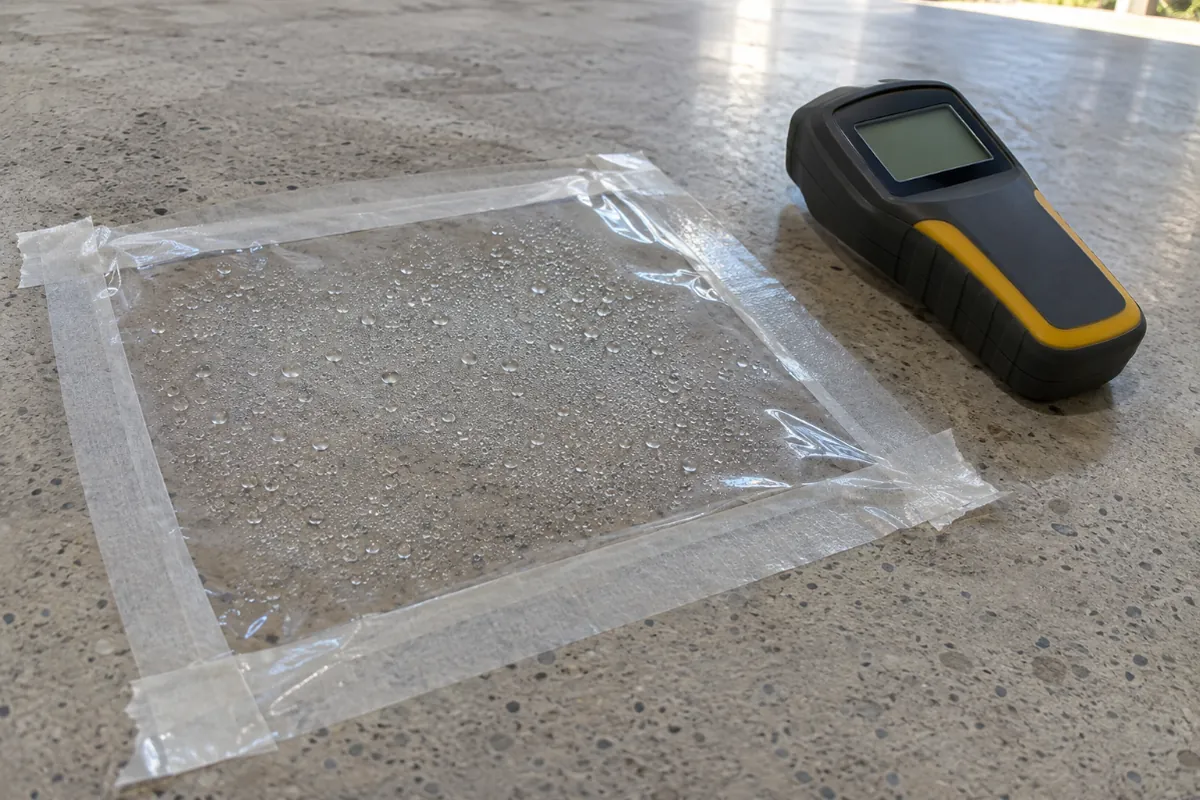
| Plastic sheet (ASTM D4263) | Whether moisture collects under taped-down plastic | A quick yes-or-no first look |
| Calcium chloride (ASTM F1869) | Pounds of water vapor leaving 1,000 sq ft of slab in 24 hours | A number to compare with the coating maker's limit |
| In-situ relative humidity (ASTM F2170) | Humidity inside the slab, read by a probe set into a drilled hole | The most telling picture of conditions at the bond line |
Plastic sheet (ASTM D4263)
- What it measures
- Whether moisture collects under taped-down plastic
- Good for
- A quick yes-or-no first look
Calcium chloride (ASTM F1869)
- What it measures
- Pounds of water vapor leaving 1,000 sq ft of slab in 24 hours
- Good for
- A number to compare with the coating maker's limit
In-situ relative humidity (ASTM F2170)
- What it measures
- Humidity inside the slab, read by a probe set into a drilled hole
- Good for
- The most telling picture of conditions at the bond line
Each coating maker sets its own moisture limit for its products. The test result is compared with that limit, not a single number for every floor.
What Happens When a Slab Tests High
- 1. Find the cause if it's local: a leaking door seal, a sprinkler aimed at the wall or a downspout draining against the slab.
- 2. Diamond grind the slab so the primer can get into the concrete.
- 3. Lay a moisture-tolerant primer rated for the reading, before the base coat.
- 4. Build the rest of the system on top: base coat, flake or color, and topcoat.
A moisture-tolerant primer costs more than a standard one, and it's the main reason the price of two floors of the same size can differ. It's much cheaper than grinding off a failed floor later.
Where We See It Most in Palm Beach County
- Older homes, including many mid-century ranches, where slabs were poured without a vapor barrier.
- Homes on lakes and canals, where the ground under the slab stays wetter.
- Garages and carports where irrigation or rain runs against the slab edge.
Asked often
Slab Moisture Questions
My garage floor looks dry. Can it still have a moisture problem?
Yes. Vapor moves through the slab without leaving the surface visibly wet, which is why installers test instead of relying on a look.
Can a damp slab still be coated?
Often, yes, with a moisture-tolerant primer rated for the reading. Some very wet slabs need the cause fixed first.
Is the plastic sheet test enough?
It's a useful first look. Calcium chloride and in-situ humidity tests give a number that can be checked against the coating maker's limit.
Why did my DIY kit blister?
Moisture is a common cause, along with thin coats over washed or etched concrete. A failed kit is ground off before a new system goes down.
Do you test every slab?
We check every slab for moisture at the estimate, and choose the primer and system based on what we find.
Sources
- Coatings Pro Magazine, Understanding Moisture Vapor Transmission and Moisture Mitigation
- ASTM D4263, Standard Test Method for Indicating Moisture in Concrete by the Plastic Sheet Method
- ASTM F1869, Standard Test Method for Measuring Moisture Vapor Emission Rate of Concrete Subfloor Using Anhydrous Calcium Chloride
- ASTM F2170, Standard Test Method for Determining Relative Humidity in Concrete Floor Slabs Using in situ Probes